Open-AudIT for Government
Full Network Visibility and Policy Compliance. Fully Self-Hosted.
Essential Eight maturity reviews, software licence audits, budget cycle reporting—government IT teams are managing more compliance obligations than ever with the same headcount. Open-AudIT handles the asset discovery, policy benchmarking, and licence tracking automatically, and because it's fully self-hosted, your data never leaves your own infrastructure.
Trusted by organisations worldwide





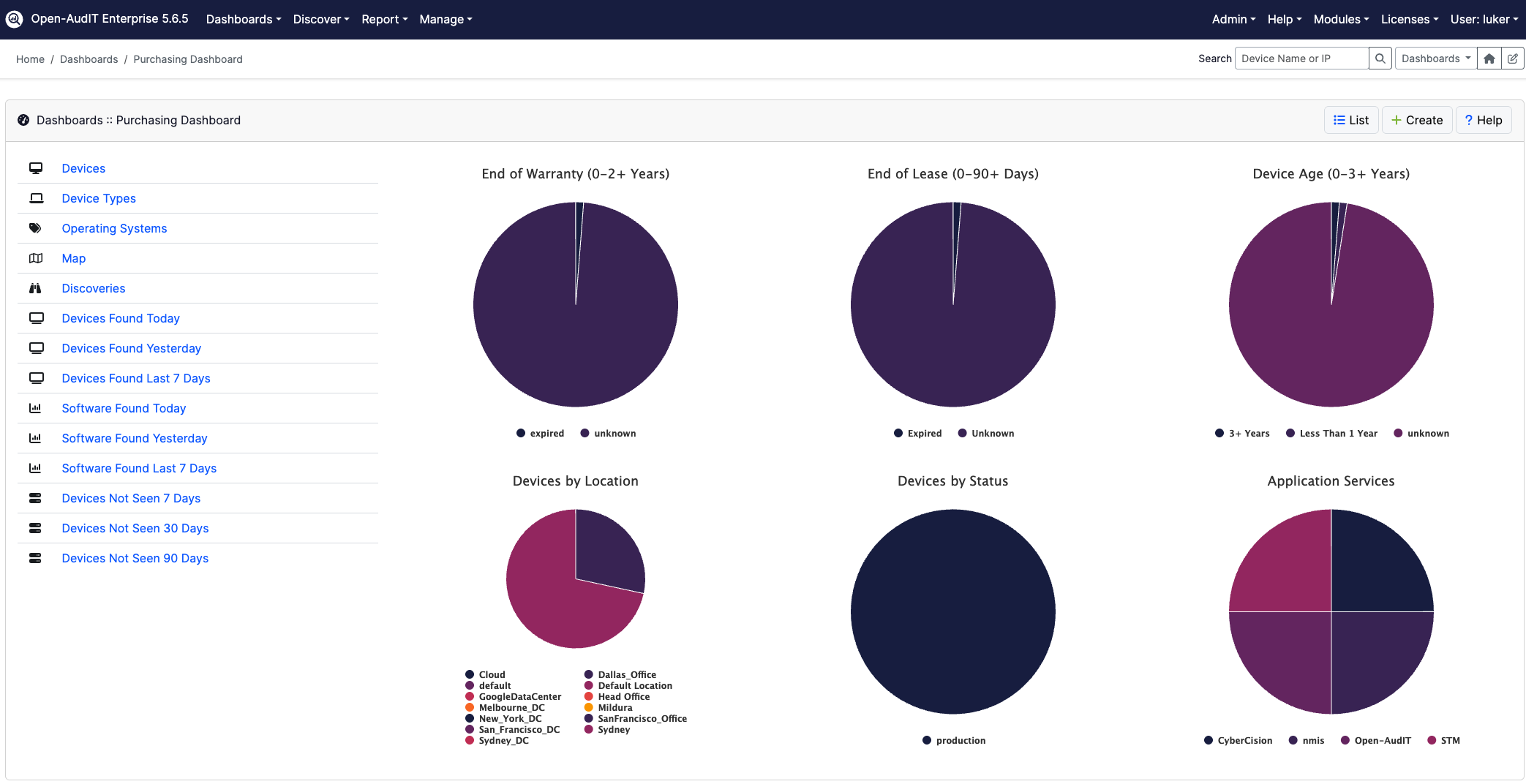
Purchasing dashboard showing warranty expiry, lease status, and device age tracking across government environments.
- Essential Eight & Policy Benchmarking
- Map your environment against ACSC Essential Eight maturity levels, NIST CSF, and CIS Controls. When gaps come up, you get device-level detail—specific machines, specific configurations—not just a summary score.
- Software Licence Auditing
- Track installed applications, version numbers, and licence status across your environment. Unlicensed software, over-provisioned applications, anything running past end-of-life—it shows up in the report rather than in an audit finding.
- Agentless Discovery Across Distributed Environments
- Scan across departments, agencies, and remote sites using SNMP, SSH, and WMI. No agents to deploy, no disruption to ongoing operations.
- Comprehensive Change Logging
- Every change to hardware, software, or network presence is recorded with a timestamp. That log becomes your audit evidence—ready to produce when your internal governance team or an external auditor asks for it.
- Self-Hosted, Data-Sovereign Architecture
- Open-AudIT runs inside your own infrastructure. Your asset data stays on your network and doesn't go anywhere else, which matters when you're managing sensitive or classified government information.
- Scheduled Discovery & Automated Reporting
- Set discovery and compliance reporting on a schedule and Open-AudIT handles the rest. Your team gets regular, consistent snapshots of the environment without it being a recurring manual task.
Use Cases
What Government IT Teams Use It For.
Government IT teams use Open-AudIT across a range of scenarios—from routine asset tracking to preparing evidence for formal compliance assessments. A few of the most common ones are below.
Essential Eight Maturity Assessment
Map your environment against all eight mitigation strategies and get device-level evidence for each one. You'll know where you meet the required maturity level and where you don't—before an ASD assessor comes asking.
See compliance features →Software Licence Compliance
Compare installed software against your approved entitlements. Unlicensed applications, unsanctioned tools, over-provisioned licences—Open-AudIT finds them and gives you the reconciliation data your finance and procurement teams need.
Change & Anomaly Detection
When something on your network changes unexpectedly—a new device, a config modification, software that shouldn't be there—Open-AudIT flags it. Your team gets a clear record of what changed and when, which matters for incident response.
Procurement & Lifecycle Planning
Track hardware age, warranty status, and end-of-life dates so when budget season comes around, you can make a data-backed case for refresh spend rather than relying on estimates or lobbying from vendors.
Multi-Agency & Distributed Site Inventory
Deploy a collector at each site or agency and pull everything into a central view. Each site's network stays independent—you're aggregating the inventory, not centralising the network access.
Audit-Ready Compliance Reporting
Generate compliance reports aligned to your policy framework whenever you need them, or put them on a schedule so they run automatically. When an audit comes up, the evidence is already there.
Explore reporting capabilities →Frequently Asked Questions
Can Open-AudIT be used to assess Essential Eight maturity?
Yes. Open-AudIT maps your environment against all eight mitigation strategies and provides device-level evidence for each one. You can identify where you meet the required maturity level and where gaps exist ahead of formal ASD assessments.
Where does the asset data get stored?
All data stays on your own infrastructure. Open-AudIT is fully self-hosted — there are no cloud components or external data transfers. This meets data sovereignty requirements for sensitive and classified government information.
How does software licence auditing work?
Open-AudIT tracks every installed application, version number, and licence status across your environment. It compares what is installed against your approved entitlements and flags unlicensed, over-provisioned, or end-of-life software automatically.
Does Open-AudIT support distributed multi-agency environments?
Yes. You can deploy collectors at each agency or site and aggregate the data into a central dashboard. Each site's network stays independent — you are aggregating the inventory, not centralising network access.
“[Customer quote placeholder — replace with a real testimonial from a government IT team.]”
Ready to Run Your First Essential Eight Assessment?
Open-AudIT can have you scanning your environment and mapping against Essential Eight in under an hour. Download it, or book a call to see it first.